Bananas are of the family Musaceae.
Globally, bananas rank fourth after rice, wheat and maize in human consumption; they are grown in 130 countries worldwide, more than any other fruit crop.
Bananas are native to tropical Southeastern Asia but are widely cultivated in tropical regions.
In 15th and 16th century, Portuguese colonists started banana plantations in the Atlantic Islands, Brazil, and western Africa. As late as the Victorian Era, bananas were not widely known in Europe, although they were available via merchant trade.
Virtually all bananas traded internationally are of a single variety, the Cavendish, the genetic roots of which lie in India. Three years ago, New Scientist revealed that the Cavendish crop was threatened by pandemics of diseases such as that caused by the black sigatoka fungus.
Now the UN Food and Agriculture Organization (FAO) has warned that wild banana species are rapidly becoming extinct as Indian forests are being destroyed, while many traditional farmers' varieties are also disappearing. It would take a global effort to save the bananas' gene pool.
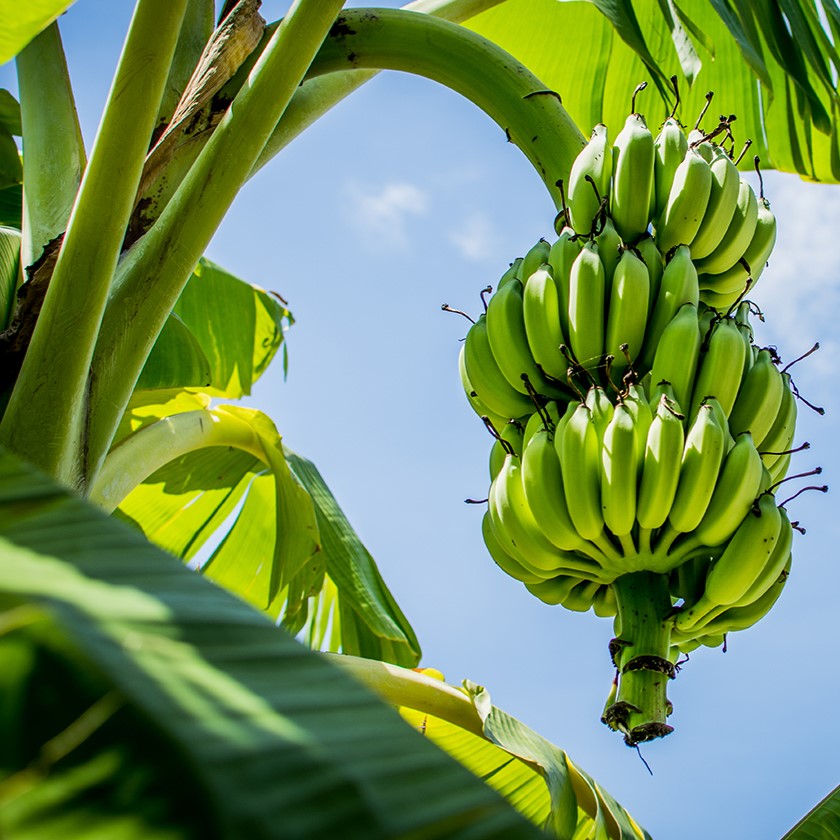
Growth Habit
- Bananas are fast-growing herbaceous perennials arising from underground rhizomes.
- The fleshy stalks or pseudostems formed by upright concentric layers of leaf sheaths constitute the functional trunk.
- The true stem begins as an underground corm which grows upwards, pushing its way out through the centre of the stalk 10-15 months after planting, eventually producing the terminal inflorescence which will later bear the fruit.
- Each stalk produces one huge flower cluster and then dies.
- New stalks then grow from the rhizome.
Foliage
- The large oblong or elliptic leaf blades are extensions of the sheaths of the pseudostem and are joined to them by fleshy, deeply grooved, short petioles.
- The leaves unfurl, as the plant grows, at the rate of one per week in warm weather, and extend upward and outward , becoming as much as 9 feet long and 2 feet wide.
- They may be entirely green, veins running from the mid-rib straight to the outer edge of the leaf.
- Even when the wind shreds the leaf, the veins are still able to function.
- Approximately 44 leaves will appear before the inflorescence emerge.
Flowers
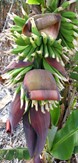
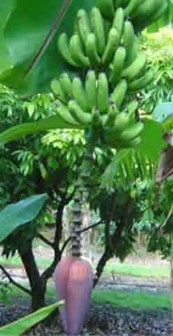
- The banana inflorescence shooting out from the heart in the tip of the stem is at first a large, long-oval, tapering, purple-clad bud.
- As it opens, the slim, nectar-rich, tubular, toothed, white flowers appear.
- They are clustered in whorled double rows along the floral stalk, each cluster covered by a thick, waxy, hood like bract, purple outside and deep red within.
- The flowers occupying the first 5 - 15 rows are female.
- As the rachis of the inflorescence continues to elongate, sterile flowers with abortive male and female parts appear, followed by normal staminate ones with abortive ovaries.
- The two latter flower types eventually drop in most edible bananas.
Fruits
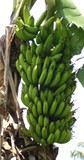
- The ovaries contained in the first (female) flowers grow rapidly, developing parthenocarpically (without pollination) into clusters of fruits, called hands.
- The number of hands varies with the species and variety. The fruit (technically a berry) turns from deep green to yellow or red, and may range from 2 1/2 to 12 inches in length and 3/4 to 2 inches in width.
- The flesh, ivory-white to yellow or salmon-yellow colour, may be firm, astringent, even gummy with latex when unripe, turning tender and slippery, or soft and mellow or rather dry and mealy or starchy when ripe.
- The flavor may be mild and sweet or subacid with a distinct apple tone.
- The common cultivated types are generally seedless with just vestiges of ovules visible as brown specks.
- Occasionally, cross-pollination with wild types will result in a number of seeds in a normally seedless variety.
Irrigation
- During summer months, irrigate once in three days.
- Ensure good drainage and prevent waterlogging.
- About 6-10 irrigations per crop may be given depending upon soil conditions.
Banana var. Nendran (October planting) grown under deep water table conditions (below 2 m from ground level) needs 10 mm (40 l/plant) irrigation once in two days during summer season to ensure higher bunch yield and better water use efficiency. Mulching the basin with 3.5 kg paddy straw (waste quality) will considerably improve the bunch yield.
Intercultural Operations
Weed control:
During early stages, complete control of weeds could be obtained by raising cowpea in the interspaces. In gardens where this is not possible, pre-emergence application of diuron 1.5 kg/ha or oxyfluorfen 0.2 kg/ha is effective. Weeds emerging later could be controlled by the application of glyphosate 0.4 kg/ha. If hand weeding is resorted to, give 4-5 surface diggings depending on weed growth. Avoid deep digging. Do not disturb soil after plants start producing bunches. If green manure crop is grown, weeding operations can be reduced to 1-2 diggings.
Desuckering:
Remove side suckers produced till the emergence of bunch. Retain one or two suckers produced after the emergence of bunch.
Intercropping in Nendran variety:
Cucumber and amaranth can be cultivated profitably with banana raised in September-October without affecting the bunch weight. For vegetable purpose, cucumber may be harvested within 95 days and for seed purpose the duration may be about 130 days. Greater yam and elephant foot yam can be profitably intercropped with Nendran.
Removal of male bud:
The part of the inflorescence which consists of male flowers only, is invariably termed in different parts of the world as male bud, heart, or navel. This has apparently no comprehensible function or value in the normal bunch formation or development.
In respect of mean duration from shooting to maturity, there was reduction of light days in the pruned plants.
In the case of yield also, there was a significant increase of 0.9 kg in the mean bunch weight of pruned plants which worked out to 7.5 per cent increase in yield.
Other advantages in pruning the male bud include extra monetary returns by sale of male buds which are used as vegetable.
It was observed that the banana thrips which attack the fruit and cause unsightly brown freckling on the fruit, live and breed in the male buds in large numbers. The removal of the male buds obviously results in less damage from this pest.
Propping of banana plants:
One of the important problems facing banana growers is the lodging of plants with mature or immature bunches during heavy winds and cyclones. The plants are uprooted or broken at the middle resulting in heavy losses to the growers.
To overcome this problem, the plants have to be propped with bamboos or caesarian poles. Single props are given. The top of the prop is placed against the throat of the plant, under the curvature of the bunch stem.
Trimming of leaves and care of banana bunches:
Leaf trimming is an important operation for controlling certain leaf diseases and for promoting light penetration.
Trimming is the removal of the dead leaves that hang down the sides of the pseudostem. It is very important that only the dead and diseased leaves are cut and removed and not the still green leaves that often hang down the side of the pseudostem.
By removing those green leaves, the photosynthetic area is reduced and the final bunch size is affected.
Leaf removal may be done throughout the growing season. By keeping the plantation clean, more light and heat are available for promoting plant growth.
Further advantages of removing dead and dried leaves are that the potential dangers of fruit injury and disease infection are reduced.
Bunch covering:
Bagging is a cultural technique used by planters in the French West Indies, Latin America, Africa, Australia, etc., particularly, where export bananas are grown.
The main purposes are the protection of bunches against cold, sun scorching, attack of thrips and scarring beetle.
It also improves certain visual qualities of the fruits. Bunch covering with dry leaves is a common practice in India, which, however, may be a source of inoculum for post-harvest diseases.
Earthing up:
Earthing up should be done during the rainy season to provide drainage, and to avoid waterlogging at the base. During summer and winter, the plants should be in furrow and on ridges during rainy season.
Pre harvest bunch spray Pre harvest bunch sprays of 3 per cent K2 SO4 (3 g in 100 ml of distilled water) twice, the first two weeks after bunch emergence and the second four weeks after bunch emergence increases the fruit yield substantially and consumer preferences in Nendran banana.
Tissue culture offers a rapid method of multiplication of quality, uniform, pest and disease free production of planting materials in large quantities in banana. The productivity of banana can be increased by cultivation of tissue culture plants of selected elite ecotypes of different varieties.
Spacing
- Give spacing of 2 m x 2 m (2500 plants/ha)
- Tissue culture plants can also be used for high density planting in Nendran banana to achieve higher returns. The spacing recommended for high density planting is as follows:
- (a) 2 m x 3 m with two plants / pit (3332 plants in 1666 pits per ha)
- (b) 1.75 m x 1.75 m with one plant per pit (3265 plants / ha)
Pit size:50 cm x 50 cm x 50 cm
Method of planting
Prepare pits 15 days in advance of planting. Fill the pits with topsoil and FYM 15-20 kg per plant per pit. Plant the tissue culture plants on the top of the pit at ground level. Remove the polythene cover completely before planting without damaging the roots. Planting may be done preferably during evening hours. Provide partial shade to plants to protect against sun scorching for about two weeks. Irrigate the crop daily during initial days of establishment.
- Bananas are harvested at various stages of its maturity depending upon the purpose for which it is cultivated, such as culinary, table purpose etc., and distance to the market (3/4 full maturity in Robusta for distant markets, while full maturity for local market etc.).
- The assessment of the harvesting maturity is itself is a skilled job. The harvesting in India is usually done by visual judging. The duration of flowering to maturation in days can also be taken as a guide for harvest index.
- In many of the perennial plantations, depending upon the time of setting of followers, the age of follower sucker at the time of setting it, cultural practices like manuring, irrigation followed will determine the time of harvest, and most often a continuous harvest all throughout the year can be obtained.
- After harvesting, the pseudostems should be cut leaving a stump of about 0.6 m height. This practice is called muttocking.
- Experimental evidence showed that the left over stump with its stored food material continues to nourish the daughter sucker (follower) till it withers and dries up.
Ripening
- Bananas are not usually allowed to ripen on the tree as it takes long time. Moreover, the fruit-peel splits, fruit ripens unevenly and fails to develop good colour and aroma, hence the marketable quality deteriorates. Therefore, banana needs to be ripened artificially.
- On arrival at the destination, the banana bunches are immediately sold to wholesale dealers who store the fruits in loose heaps in godowns and ripen them in lots as per the need of the retail dealers.
- In tropical conditions, fruits for local consumption are harvested and ripened by hanging the bunches in a shady place or a ripening hut.
- Smoke treatment is the commonest method to induce ripening in Maharashtra and Tamil Nadu. Smoking is done with straw, leaves and cowdung in a closed chamber with bunches arranged in a heap for 18-24 hours in summer and 48 hours in winter.
- After taking the bunches from the chamber they are placed in a well-ventilated room for development of colour.
- Smoke treatment causes ripening of the bunches within 3 days. Ripening is also done by keeping the bunches covered with gunny sacks.
Storage
- Banana can be stored at a temperature slightly above 550 F (130 C) and a relative humidity of 85 to 95 per cent for about three weeks, and is ripened in a week or two at 62-700 F (16.5-210 C).
- Banana fruit becomes blackened at lower temperatures and should not be placed in a refrigerator. Internally, the banana is carried either by rail or by road in unrefrigerated carriage.
- On the other hand, the produce for overseas trade is carried in refrigerated ships, the banana being kept in a cool air circulation at about 52-560 F (11-13.50 C). Premature ripening is probably the biggest single cause of loss during storage.
- Keeping the fruit in relatively high concentration of CO2 and low concentration of O2 can prolong storage life.
- Dipping of bananas at 200 ppm TBZ has been approved and recommended as a post-harvest treatment.
- A double coating of 12% wax emulsion prolonged the storage life of Dwarf Cavendish banana by 10-12 days at 580 F (14.50 C).
Packing & Transport
- The banana bunches harvested at apt age of maturity are wrapped with dried banana leaves before packing into in lorries or railway wagons for long distance transport. This practice is in vogue in commercial orchards of Maharashtra, Bihar, etc.
- At destination the bunches of Dwarf cavendish, poovan etc. are dehanded and sold in retail outlets, whereas in the markets whole bunches as such are marketed.
- In Kerala, the Nendran bunches are marketed as whole bunches itself. Often male buds are not even removed to give a better show for the whole bunch during festive seasons.
Process Protocol for Banana flour production
The banana powder is prepared by drying
banana slices at 70o
C for 24 h, which was pretreated with 0.5% citric acid for 10 min, in a
convective dryer. An ethnic health mix was
also developed out of Nendran banana flour
and sugar (75:25). The best proportion of
Nendran banana flour and sugar were
selected based on the nutritional and sensory
quality parameters. The new product could be
stored for more than six months using suitable
packaging technology
RTE Snacks from starch based food products
An extruded Ready To Eat (RTE) snack
food product was developed out of starch
based food products such as rice, cassava and
Nendran banana at optimized process
parameters viz; temperature (180o
C), screw
speed (100 rpm) and moisture content (16%)
using a single screw exruder. The best
proportion of rice: banana and cassava
(10:80:10) was selected based on the
nutritional, engineering, textural and sensory
quality parameters. The new RTE product
could be stored for more than six months using
suitable packaging technology